Last updated: 30 Jun 2026
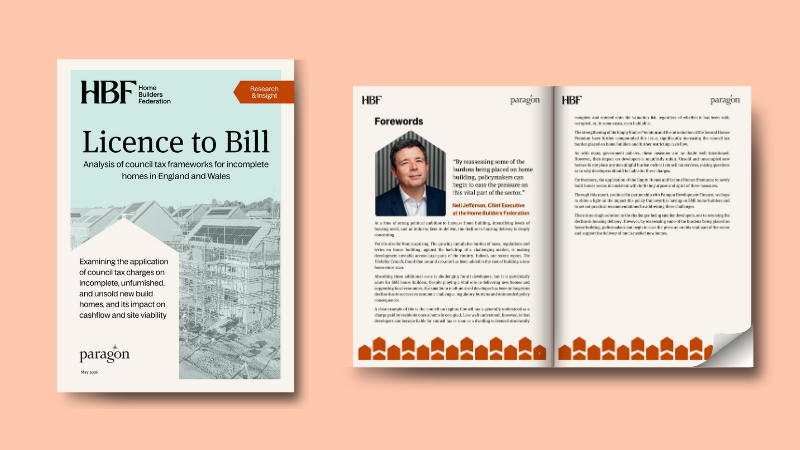
Licence to Bill
Analysis of council tax frameworks for incomplete homes in England and Wales
Contents
Forewords

“By reassessing some of the burdens being placed on home building, policymakers can begin to ease the pressure on this vital part of the sector."
Neil Jefferson, Chief Executive
Home Builders Federation
At a time of strong political ambition to increase home building, intensifying levels of housing need, and an industry keen to deliver, the decline in housing delivery is deeply concerning.
Yet it is also far from surprising. The growing cumulative burden of taxes, regulations and levies on house building, against the backdrop of a challenging market, is making development unviable across large parts of the country. Indeed, our recent report, The Viability Crunch, found that around £76,000 has been added to the cost of building a new home since 2020.
Absorbing these additional costs is challenging for all developers, but it is particularly acute for SME house builders. Despite playing a vital role in delivering new homes and supporting local economies, the smaller to medium sized developer has been in long-term decline due to successive economic challenges, regulatory burdens and unintended policy consequences.
A clear example of this is the council tax regime. Council tax is generally understood as a charge paid by residents once a home is occupied. Less well understood, however, is that developers can become liable for council tax as soon as a dwelling is deemed structurally complete and entered onto the valuation list, regardless of whether it has been sold, occupied, or, in some cases, even habitable.
The strengthening of the Empty Homes Premium and the introduction of the Second Homes Premium have further compounded this issue, significantly increasing the council tax burden placed on home builders and further restricting cash flow.
As with many government policies, these measures are no doubt well intentioned. However, their impact on developers is manifestly unfair. Unsold and unoccupied new homes do not place any meaningful burden on local council tax services, raising questions as to why developers should be liable for these charges.
Furthermore, the application of the Empty Homes and Second Homes Premiums to newly built homes seems inconsistent with both the purpose and spirit of these measures.
Through this report, produced in partnership with Paragon Development Finance, we hope to shine a light on the impact this policy framework is having on SME home builders and to set out practical recommendations for addressing these challenges.
There is no single solution to the challenges facing smaller developers, nor to reversing the decline in housing delivery. However, by reassessing some of the burdens being placed on home building, policymakers can begin to ease the pressure on this vital part of the sector and support the delivery of much-needed new homes.

“This report’s recommendations would improve predictability and cost control for developers, whilst giving lenders greater confidence."
Neal Moy, Managing Director
Paragon Development Finance
SME developers are critical to maintaining housing delivery, but their operating environment is fragile. Despite the role they play in regenerating local communities and bringing forward smaller sites, a combination of planning delays, uneven demand and volatile build costs and liabilities are increasingly undermining scheme viability.
This report examines a pressure that is still poorly understood outside the housebuilding sector: council tax burdens that arise before homes are sold, occupied, and often before they are habitable in any practical sense. Council tax is widely seen as a charge for residents to fund local public services they use. However, through Completion Notices and early valuation listing, liability can be triggered at points that do not reflect construction or sales timelines, leaving developers carrying costs with no associated income.
This creates a pinch point for SMEs who, unlike bigger players, rarely have liquidity to absorb unexpected holding costs, especially where sales are delayed for reasons beyond their control. What’s more, recent policy changes heighten this risk. Councils now have the power to apply an Empty Homes Premium after one year, rather than two, and charge up to a 100% premium on second homes. This signals a direction of travel in which authorities use premiums to raise revenue.
Paragon Development Finance works with hundreds of SMEs nationwide, funding over 13,000 new homes since 2018. We see firsthand how early and inconsistent council tax charges constrain delivery.
One experienced developer we work with, delivering an eight-unit scheme in the Southeast, is facing a minimum £12,000 council tax bill for homes that were structurally complete but uninhabitable or sellable for several months. Another client has had to make additional funding in excess of £50,000 available to meet council tax liabilities on homes reaching practical completion – despite some units taking up to six months thereafter for sales to be processed.
These cases are not unique and sit uneasily when compared with the housing delivery data. To meet Government’s 1.5 million homes pledge, housebuilders would need to deliver around 300,000 net new dwellings a year, yet official figures show output running around 30% below that pace.
That is why we partnered with HBF to support this research. Its recommendations will improve predictability and cost control for developers, whilst giving lenders greater confidence.
Introduction
SME home builders are facing a range of increasingly acute challenges that are affecting their ability to deliver much-needed new homes. While barriers such as delays in the planning system, rising build costs, and constrained housing demand are widely recognised, the growing impact of the council tax regime on developers has received far less attention.
Council tax is typically understood as a charge borne by residents once homes are occupied. However, what is underappreciated is that developers can become liable for council tax as soon as a dwelling is deemed complete and entered into the valuation list, regardless of whether it has been sold or occupied – or even whether it is actually completed. In addition, the strengthening of the Empty Homes Premium and the introduction of the Second Homes Premium have further increased the inappropriate council tax burden on home builders.
For SME developers in particular, these changes have created new and often unpredictable financial pressures. SMEs typically operate with limited access to capital and rely heavily on the timely sale of completed homes to recover costs and reinvest in future projects. The imposition of council tax, in some cases at a premium to the standard prevailing rate, can therefore have a significant impact on cash flow, development viability, and the ability to bring forward further sites.
Following increasing concerns from SME developers, HBF and Paragon Bank have undertaken an in-depth investigation to help shine a light on these largely unrecognised challenges. As part of this investigation, we have examined the legislative and administrative framework governing council tax liability for new build homes, including the role of Completion Notices, the application of empty homes and second homes premiums, and the extent to which these policies are affecting SME developers in practice.
Drawing on extensive Freedom of Information responses from local authorities, alongside industry evidence, the report highlights inconsistencies in the application of the regime, the financial implications for SME home builders, and the unintended consequences for housing delivery.
Summary of findings
- Significant variation in how completion is defined and applied
There is considerable inconsistency between local authorities in determining when a new build home is deemed complete for council tax purposes. While most authorities refer broadly to structural completion or the stage at which a property is capable of being completed within three months, the specific criteria used and the stage of construction at which Completion Notices are issued varies widely. This lack of standardisation creates uncertainty for developers and can result in council tax liability arising at different stages of the build process depending on location.
- Limited availability of empty property discounts
Almost half of local authorities (45%) do not offer any council tax discount for newly completed properties that are unoccupied and substantially unfurnished. This means that in many areas, developers become liable for the full council tax charge immediately once a property is entered into the valuation list, regardless of whether it has been sold or occupied. This represents a significant departure from the previous national Class C exemption and has increased costs for developers, creating additional risk in the development process.
- Material impact on SME developer viability and cash flow
Council tax liability is having a direct and widespread impact on SME home builders. Survey evidence shows that 88% of SME developers report that council tax charges are affecting their cashflow and therefore impacting development viability. Given the importance of timely sales in enabling SMEs to recycle capital into new projects, additional costs associated with council tax can constrain their ability to invest in future housing delivery.
- Rising number of appeals shows growing dispute and uncertainty
The number of appeals to the Valuation Tribunal Service relating to Completion Notices has increased significantly in recent years. Appeals recorded in the 2025–26 financial year were 154% higher than in 2022–23, indicating a growing number of disputes over when properties are deemed complete for council tax purposes. This trend suggests increasing tension between developers and local authorities and reinforces concerns about the clarity, consistency, and application of the current regime.
The legislative framework
The Local Government Finance Act 1992 introduced Council Tax in England, Scotland and Wales. It came into effect on 1 April 1993, replacing the Community Charge, more commonly referred to as the “poll tax”.
Council tax is charged on domestic properties, with rates set by individual local authorities to fund local services. While it is generally well understood as a charge payable by the owner or tenant of a residential property, it is less well known that in the case of new-build homes, council tax is also frequently levied on developers prior to sale or occupation.
The mechanism for charging council tax on newly built properties is the serving of a Completion Notice. A Completion Notice is issued where a newly constructed building is considered complete, or is expected to be completed within three months, for council tax purposes. Once the notice takes effect, the property is entered into the valuation list and council tax becomes payable (subject to any exemptions or premiums).
A Completion Notice is issued in accordance with the following provisions.
- Section 17 of the Local Government Finance Act 1992 and Local Government Finance Act 1988, Schedule 4A
The statutory framework for council tax completion notices was provided in section 17 of the Local Government Finance Act 1992. It placed an obligation on billing authorities to issue completion notices under the provisions of Schedule 4A to the Local Government Finance Act 1988 (which had previously only applied to non-domestic properties).
Section 17 essentially allowed both complete and incomplete dwellings to be deemed to have come into existence for council tax purposes. Schedule 4A provided the rules within which each billing authority had to operate1.
The key elements of Schedule 4A are as follows:
- Paragraph 1(1) of Schedule 4A: “If it comes to the notice of a billing authority that the work remaining to be done on a new building in its area is such that the building can reasonably be expected to be completed within three months, the authority shall serve a notice under this paragraph on the owner of the building as soon as is reasonably practicable unless the valuation officer otherwise directs in writing.”
- Paragraph 2(2) of Schedule 4A: “Where at the time a completion notice is served it appears to the authority that the building to which the notice relates is not completed, the authority shall propose as the completion day such day, not later than three months from and including the day on which the notice is served, as the authority considers is a day by which the building can reasonably be expected to be completed.”
As such, the Valuation Tribunal for England writes that the “Billing Authority is under a statutory duty to serve a council tax completion notice in respect of a complete dwelling or one where the work remaining to be done could reasonably be expected to be completed within three months. The authority could propose a date of completion it considered was reasonable”2.
At what stage are new build homes considered ‘complete’ or capable of being completed within three months?
The challenge for home builders is that the legislative framework does not provide a definitive or prescriptive definition of what constitutes a completed property, or the point in the build process when a property can reasonably be expected to be completed within three months.
Unlike the issuing of a warranty certificate or Building Control Completion Certificate, which typically occurs when a property is ready for occupation, a Local Authority Completion Notice for the purpose of collecting council tax can be issued at an earlier stage in the build process.
To better understand the approaches that individual Local Authorities are taking in practice, HBF issued a Freedom of Information (FOI) request to Local Authorities in England and Wales. Specifically, Local Authorities were asked:
- “For the purposes of serving a Completion Notice for council tax, at what stage of construction does the authority consider a property to be “substantially complete” or “capable of being completed within three months”?
186 Local Authorities responded to the FOI request by the deadline. While the responses demonstrated a high level of consistency in how local authorities interpret “substantial completion” for the purposes of serving a Council Tax Completion Notice, there is still considerable local variation, resulting in uncertainty for developers.
The key themes from the results are summarised below.
- A predominantly structural threshold. Many authorities apply a primarily physical/structural test. A dwelling is commonly treated as “substantially complete” once the main shell is formed and the building is wind and watertight, with the roof and external walls in place. Many responses also cite the completion of the internal “shell” as key indicators, typically internal partitions erected and floors laid (often noting that a screed or final topcoat is not required).
- Finishes and fit-out are rarely determinative. A consistent theme is that a property does not need to be fully finished or ready for occupation in the typical sense. Many councils explicitly state that internal decoration, snagging, floor coverings, and final fixtures and fittings do not need to be complete for a Completion Notice to be served or for banding to proceed. Kitchens and bathrooms are frequently referenced as works that may be outstanding, particularly where only final installation or connection remains.
- Utilities generally need to be laid but not necessarily connected. Many authorities consider it sufficient for services to be laid to the site or available at the boundary, without requiring live connection or commissioning at the point of notice. However, a smaller group place greater weight on whether utilities are connected or readily connectable.
- Build stages used as practical triggers. Several local authorities refer to first fix / pre-plaster as the point at which completion within three months becomes realistic. Others identify second fix (or the commencement/near completion of second fix) as the stage at which a property is typically regarded as substantially complete and suitable for banding, with any notice period reduced where internal works are already advanced.
- Case-by-case discretion and inspection-led decision making. Many councils emphasise that they do not operate a rigid checklist and instead make decisions on a case-by-case basis, typically following site inspections, photographs, and assessment by an officer. Several note the importance of liaison with developers/owners to agree realistic completion dates and to account for factors such as delayed utility connections.
Overall, the evidence suggests a prevailing approach in which “substantial completion” is treated as the point at which the building is structurally complete and weather-tight, with the internal shell established, and where remaining works are non-structural and capable of being completed within a short period, even if the dwelling is not yet fully fitted out or occupied.
However, these findings do not fully capture the extent of variation in how this threshold is applied in practice. For developers, this can create significant uncertainty, as the stage at which a property is deemed complete, and therefore becomes liable for council tax, may vary considerably between local authorities, with direct implications for cash flow.
Furthermore, while structural completion provides a clear physical benchmark, it does not necessarily reflect the practical realities of completing and bringing a home to market. Delays in utility connections, labour availability, or materials shortages, often outside the developer’s control, may mean that properties deemed “substantially complete” for council tax purposes remain some distance from being ready for sale or occupation.
As a result, council tax liability will likely arise at a point that does not align with either practical completion or the point at which the developer is able to realise value from the dwelling.
How widely are council tax discounts used by Local Authorities?
Under the Local Government Finance Act 1992, newly built dwellings in England were previously eligible for a mandatory Class C council tax exemption. This provided a 100% exemption from council tax for up to six months where a property was unoccupied and substantially unfurnished.
However, from 1 April 2013, amendments introduced by the Local Government Finance Act 2012 abolished the mandatory Class C exemption. In its place, billing authorities were given discretion to determine whether to offer a discount, and at what level, within a range of 0% to 100%. This marked a shift from a nationally consistent exemption to a locally determined system, resulting in significant variation in the level of support available to developers across different areas.
With more than a decade having passed since these changes were introduced, HBF sought to understand how local authorities are exercising their discretion in practice. As part of its Freedom of Information exercise, HBF asked local authorities whether full council tax charges are applied to newly built dwellings that are unoccupied, unfurnished, and unsold, or whether any form of discount or exemption is made available.
The responses demonstrate that a substantial proportion of local authorities apply full council tax liability from the date a property is entered into the valuation list or from the effective date of a Completion Notice, with approximately 45% offering no empty property discount at all. In these areas, unoccupied and unfurnished new build dwellings are subject to a 100% charge from day one, regardless of sale status.
While a slight majority of authorities provide some form of short-term empty property discount, this relief is typically limited in duration, creating additional sales risk for SME home builders. The most common model is a 100% discount for one month, after which the full charge becomes payable. A smaller number of authorities allow relief for longer periods, typically two to three months, and in some cases up to six months, occasionally followed by a tapered reduction before full liability applies.
Notwithstanding these variations, the overall position remains that council tax liability arises quickly following completion. Even where short-term relief is available, it is generally modest and time limited.
Furthermore, a small number of authorities indicated that their current empty property discounts will be withdrawn from 1 April 2026, after which full council tax liability will apply from the date of banding or completion. Given the increasing financial pressures facing local authorities, and the wider policy emphasis on maximising revenue and discouraging empty homes, the removal of discretionary discounts is not unexpected.
Can developers appeal the dates provided in completion notices?
Given the lack of statutory clarity around what constitutes “complete” or “substantially complete” property, it is essential that developers have a clear and effective route of appeal where they disagree with the date specified by a local authority in a completion notice.
As noted above, some authorities adopt a pragmatic, case-by-case approach and engage with developers to agree realistic completion dates. However, this approach is not applied consistently across all areas.
Moreover, construction milestones that are sometimes treated as reliable indicators of likely completion, for example, first fix or pre-plaster stages, which several authorities cite as the point at which completion within three months becomes realistic, may not, in practice, guarantee completion within that timeframe. Delays relating to labour availability, materials supply, or utility connections can arise through no fault of the developer and may materially affect build programmes.
In such circumstances, the ability to question or appeal completion dates is an important safeguard against premature liability.
A completion notice may be served up to three months in advance of the day on which the LA specifies that a property is complete. If a developer disagrees with the date outlined in the completion notice, they should appeal in writing within 28 days of the date of service to the Valuation Tribunal Service.
As part of its FOI exercise, HBF requested data on the number of appeals lodged with the Valuation Tribunal for England against Council Tax Completion Notices, broken down by financial year.
While the Tribunal was unable to isolate appeals relating solely to residential development, the figures nevertheless indicate a clear upward trend. For example, the number of appeals recorded in the 2025–26 financial year (for which data was available) was 154% higher than in 2022–23.

In relation to the outcome of these appeals, the Valuation Tribunal Service noted that, unlike most other council tax appeal types, Completion Notice appeals are made directly to the Tribunal rather than first to the billing authority. As a result, once an appeal is lodged, discussions often take place between the parties regarding the completion date, and many appeals are subsequently withdrawn following those discussions.
As such, a follow-up question asked how many of the appeals received were allowed in each of those financial years. When removing the appeals that were withdrawn, the data shows a marked increase in both the volume of Completion Notice appeals and the number allowed (or allowed in part) over the period.
- In 2022/23, only 4 appeals were allowed (just over 10% of the 39 appeals determined that year).
- In 2023/24, allowed appeals rose sharply to 37, representing nearly 60% of all appeals determined (37 out of 62).
- In 2024/25, the number fell back to 11 allowed appeals (approximately 16% of total appeals that year).
- However, in 2025/26, both the total number of appeals and the number allowed increased significantly. 103 appeals were allowed or allowed in part, compared with 107 dismissed. While the proportion allowed (around 47%) was broadly balanced against dismissals, the absolute number represents a substantial rise compared with earlier years.


While appeal outcomes vary year to year, the overall picture is one of rising challenge activity and a growing number of Completion Notices being overturned or varied by the Tribunal. The sharp increase in allowed appeals in 2025/26, both in absolute and relative terms compared to 2022/23, suggests that disputes over completion dates are becoming more frequent and, in a significant proportion of cases, are being found to have merit.
To better understand how negotiations play out at a local level, Local Authorities were asked:
- How many instances in each of the past three financial years has a developer challenged the completion date set out in a Completion Notice served on a new build dwelling that is unoccupied, unfurnished, and unsold?
- Of these instances, in how many cases has the authority withdrawn the original Completion Notice and issued a new notice with a revised date?
However, the most common pattern across responses is that the requested information is not held, not recorded, or not readily extractable. A substantial majority of authorities stated that:
- They do not maintain a central record of challenges to completion dates.
- Challenges are dealt with informally and on a case-by-case basis.
- Systems do not separately log disputes relating specifically to new build, unoccupied, unfurnished, and unsold dwellings.
- Extracting such data would require manual review and, in some cases, would exceed the appropriate limit under the Freedom of Information Act
As such, understanding the true scale of the number of completion notices being varied by local councils is difficult to ascertain.
The Second Homes Premium and Empty Homes Premium
The introduction of the Second Homes Premium and changes to the Empty Homes Premium have further increased council tax liabilities for some developers.
Empty Homes Premium
The Empty Homes Premium was introduced in England in 2013, granting local authorities the power to levy an additional council tax charge on properties that remain unoccupied and substantially unfurnished for extended periods.
Initially, councils were only able to apply the premium once a property had been empty for at least two years. However, from April 2024, local authorities were given the discretion to impose the premium after just one year of vacancy.
Local authorities also have discretion over whether to apply the premium within their area, and at what level, up to the statutory maximum.
As such, these costs present a significant challenge for developers, particularly SME homebuilders, whose business models depend on the timely sale of completed units to recover capital and fund future projects.
Indeed, it is important to recognise that no home builder aims to carry standing stock. The objective is to build and sell as efficiently as possible, with construction programmes planned so that homes are sold, and ideally occupied, upon completion, or even pre-sold off-plan.
Unsold homes tie up capital and increase financial exposure, and are therefore actively avoided. Against this backdrop, the imposition of additional council tax charges on completed but unsold properties places further pressure on cash flow and can limit a developer’s capacity to initiate or progress subsequent sites.
These costs can be particularly acute where delays in sales arise due to factors outside the developer’s control, such as broader housing market conditions, mortgage affordability constraints, or delays within property chains. In these circumstances, the vacancy does not reflect a deliberate decision to leave homes empty, but rather the commercial realities of bringing new homes to market in a challenging environment.
While this issue can affect all parts of the sector, it is particularly acute for retirement housing developers, reflecting the distinct characteristics of their product and customer base. Retirement housing schemes typically include extensive communal facilities, and purchasers often prefer to see both the homes and shared amenities fully completed, and to meet on-site staff, before committing to a purchase. Consequently, off-plan sales are less common than in the general housing market.
The sales process is also inherently longer due to the needs and circumstances of purchasers. Prospective buyers frequently undertake multiple visits, often accompanied by family members, before making a decision. In addition, many purchasers must first sell an existing family home, which may itself require refurbishment or adaptation prior to sale.
Taken together, these factors mean that the period between initial enquiry and legal completion can extend over many months, and in some cases years, even where demand exists and properties are actively marketed.
Second Homes Premium
The Second Home Premium was introduced in April 2025, giving local authorities the power to levy an additional council tax charge of up to 100% on second homes within their area. For council tax purposes, a second home is defined as a dwelling that is substantially furnished but is not occupied as anyone’s sole or main residence.
As with the Empty Homes Premium, it is for councils to decide whether to charge the premiums in their local area and at what rate, up to the statutory maximum.
The Second Home Premium also has implications for developers. While most unsold new build dwellings are unfurnished and therefore fall within the empty homes regime, developers may furnish selected units for marketing purposes, such as show homes.
Where these properties are substantially furnished but not used as a sole or main residence, they may fall within the definition of a second home and become liable for the premium once the initial exemption period (one year) has elapsed. This can therefore increase the costs associated with marketing and selling new developments.
Deployment of Empty Homes Premium and Second Homes Premium by Local Authorities
The deployment of the Empty Homes Premium and Second Homes Premium by Local Authorities in England is widespread and recorded by the Ministry of Housing, Communities and Local Government (MHCLG).
In its latest release of the Local Authority Council Taxbase in England for 2025, the statistics showed that:
- In 2025, 291 out of 296 authorities reported they were charging the Empty Homes Premium on some of their empty dwellings.
- Following its introduction, 211 out of 296 authorities (71%) reported charging the Second Homes Premium in 20253.
Impact of council tax liabilities on SME developers
In light of the increasing council tax liabilities faced by developers, HBF surveyed more than 100 SME home builders to assess the extent to which council tax charges levied on new build homes, including the Second Homes Premium and Empty Homes Premium, impact business cash flow and development viability.

The results found that almost nine out of ten developers (88%) considered that council tax was having an impact on their cash flow and development viability4.
Most concerningly, 42% reported that the impact was either moderate, significant or severe5.
"We have many new homes finished and unsold - the empty rates premium is crippling our cash flow and eating away any final profits left - this element is massively detrimental to us as an SME developer” – HBF SME Developer Sentiment Survey Q1 respondent

In terms of company size, respondents for whom council tax was impacting cash flow and development viability ranged from the smallest developers (delivering 1–10 units per annum) to those at the upper end of the SME spectrum (delivering 500+ units per annum).
Case Studies
Bedfordshire
Background
A small housing developer operating in the Northern Home Counties is currently facing ongoing challenges arising from a Local Authority’s application of the Empty Homes Premium to two properties on a development site in Central Bedfordshire.
Upon completion, the scheme will deliver 25 homes, including two Affordable Homes. The development has been continuously and actively marketed since launch, with sales activity driven from an on-site show home.
Application of Empty Homes Premium
However, in the context of challenging market conditions, a number of properties remain unsold despite the best efforts of the developer. Compounding this situation, the Local Authority has determined, based on individual plot “release” dates, that two of the homes are liable for the Empty Homes Premium, resulting in a potential cost to the developer in excess of £8,000.
The developer contends that these properties should not be classified as long-term empty homes in the conventional sense. Rather, they are newly completed dwellings awaiting sale as part of the normal course of development, with ongoing marketing activity, buyer enquiries, and active reservations.
Developer and Local Authority response
In response, the developer requested that the Council exercise its discretionary powers under Section 13A to remove the Empty Homes Premium in respect of the unsold units. However, the Local Authority declined the request, stating that the circumstances did not meet the hardship criteria set out in its Section 13A policy.
Ultimately, the primary purpose of the Empty Homes Premium is to discourage properties from being left empty and unused over extended periods, not to penalise newly built homes that are actively being marketed and contributing to housing supply and local economies.
A formal request for reconsideration has now been submitted by the developer, and the case remains ongoing.
Hampshire
Background
An SME house builder operating in the South East has recently delivered a residential scheme in Hampshire consisting of nine family homes, comprising a mix of 3-4 bedroom properties.
Council Tax charges on unsold properties
During the sales phase, the developer was required to pay Council Tax on “completed” but unsold homes. Charges ranged between £220 and £320 per property, per month, a significant outlay for a small developer.
Across the nine-unit site, this resulted in a total Council Tax bill exceeding £3,000 despite the properties being unoccupied.
Inconsistency across Local Authorities
A key concern highlighted by the developer in this case study is the lack of consistency between Local Authorities regarding when Council Tax becomes payable.
In their experience, some councils begin charging only once homes are clearly habitable, while others impose charges much earlier, at times when properties are effectively still construction sites. This inconsistency creates uncertainty and results in unforeseen charges for developers operating across multiple Local Authorities.
The developer also notes that certain authorities are particularly proactive in monitoring sites and initiating charges early in the construction of the development.
Perceived disconnect between charges and services
Unsurprisingly, the developer challenges the rationale for imposing full Council Tax liability on empty properties. By their very nature, unoccupied dwellings do not give rise to the same level of demand for local services as occupied homes, particularly in respect of provisions such as waste collection, education, or social care. From this perspective, the blanket application of full Council Tax appears disproportionate to the actual burden placed on Local Authorities.
The developer has previously sought to engage with the local authority to explore a more proportionate approach, including proposals to limit liability to the cost of essential standby services such as fire services and policing. However, the authority has maintained its position that full charges remain applicable.
Impact on business viability
While Council Tax alone may not halt a development, it contributes to the cumulative financial pressures developers are facing, particularly when:
- Homes take longer to sell in a slower market
- Development finance interest continues to accrue
- Profit margins are already constrained
For SME developers, these additional holding costs can significantly erode profitability and increase risk exposure.
Implications for Housing Delivery
The developer considers that the cumulative burden of taxes, fees, and regulatory costs, coupled with ongoing delays in the planning process, is eroding the viability of development opportunities.
This in turn constrains their capacity to grow the business and, more broadly, to contribute to the delivery of much-needed new housing.
“We already pay a vast amount of taxes and contributions on our sites as an SME – contributions of which have become unnecessarily crippling” – SME Developer
Surrey
Background
A small developer in the Home Counties is converting a former Officers’ Mess in Surrey into 33 apartments, preserving much of the building’s original character while adding modern features such as electric vehicle charging. The project is part of a wider development of 1,200 homes.
The Local Authority has tried to serve a completion notice on the developer since an early stage of construction, when roofs were still being recovered. The developer says that two council officials often visited the site unannounced at least once a month and without the required Personal Protective Equipment (PPE).
When the road and apartment blocks were named early in construction, the council refused to issue postcodes unless the developer confirmed the plots were ‘complete’, even though they were still uninhabitable.
Fortunately, because power had not yet been connected, the council could not serve notice. Had it been able to do so, the developer would have faced around £50,000 in council tax on unfurnished, incomplete and unoccupiable apartments.
When the developer confirmed on 6 November 2025 that the first plot was ready for occupation, the council immediately served notice on all 33 plots.
As of 30 April 2026, the developer has been invoiced £18,968.37 in council tax and continues to pay these charges.
Engagement with the Local Authority
The developer remained engaged with the Local Authority throughout the process.
However, while the council was trying to serve notice, it acknowledged that its planning officer had not yet discharged the planning conditions needed for occupation. The developer was told this was a separate department and therefore outside the council tax team’s control.
Impact of charges
The developer believes the council tax regime has a disproportionate impact on SMEs. Larger sites can often sell homes off plan from a show house and build in line with sales rates, but many SME developers must complete schemes in a single phase.
It is also important to note that developers build homes to sell. Unsold plots already create holding costs, and because no one is living in them, they make little use of council-provided services.
In addition, Second Home Premiums of 100% after 12 months, often based on a fictional completion date, create a further financial burden.
Buckinghamshire
This case concerns a small residential scheme comprising nine freehold homes in Buckinghamshire.
The development consisted of a mix of detached, semi-detached, terraced, and end-of-terrace homes ranging from two to four bedrooms.
Council tax liability following completion
Construction of the scheme was completed during 2023. Following completion, Buckinghamshire Council imposed council tax liabilities on the vacant properties before any homes had sold, and when sales were hard.
The council applied 100% council tax as follows:
- From 1 July 2023 on Plots 1, 2 and 3 until 31 March 2024
- From 1 July 2023 on Plots 4 and 5 until 31 March 2024
- From 20 September 2023 on Plots 6, 7, 8 and 9 until 31 March 2024
Plot 3 sold on 7 March 2024.
From 1 April 2024 to 30 March 2025, the developer was charged full (100%) council tax on the remaining unsold plots (plots 1, 4, 5, 6, 7, 8 and 9.)
Several plots remained unsold during the 2024/2025 tax year despite ongoing marketing efforts.
When the developer challenged the council’s decision to charge full council tax despite the properties being unsold and unoccupied, they were taken to court within two weeks for non-payment and were refused payment by instalments.
Escalation to Empty Property Premium
The situation intensified further when the local authority imposed a 100% empty homes premium on two plots the developer had difficulties selling (plots 4 and 6), effectively doubling council tax liability to 200%, from 1 April 2025.
The authority initially attempted to argue that all properties had effectively been released for sale at the same time, which would have accelerated the timing for premium charges across the development.
However, the developer maintained that plots were launched gradually as other homes sold.
The actual launch dates were:
- Plot 6: first marketed on 14 February 2024
- Plot 4: first marketed on 21 September 2024
The developer appealed the council’s interpretation and was required to provide sales literature, marketing records, supporting documentation, and evidence of launch dates.
Following a review of the evidence:
- The 200% premium on Plot 6 remained in place because the council concluded the property had been marketed continuously for more than 12 months before the premium was introduced.
- The premium on Plot 4 was removed, with an exemption applied from 1 April 2025 because the property had only been marketed from 21 September 2024.
While the removal of the premium on Plot 4 was positive, it is nevertheless the case that the holding costs associated with council tax and delayed sales created significant financial strain on the scheme.
This is unfair to the developer, who was making every effort to sell the properties, including:
- Reducing the asking price by £150,000
- Converting the roof space into additional accommodation to make the property more marketable
The application of Empty Homes Premiums to newly built properties that are actively being marketed for sale is contrary to the original intention of the policy, which was designed to bring long-term vacant existing homes back into use, and unfairly penalises developers who are delivering much-needed housing rather than deliberately leaving properties empty.
Show home business rates dispute
The developer also faced a separate dispute over Plot 2. Buckinghamshire Council classified Plot 2 as a “show home” and charged business rates from 1 July 2023 at about £24,500 a year.
However, the developer believed this designation was incorrect under Valuation Office Agency (VOA) guidance and challenged the decision.
Ultimately, the developer succeeded in overturning the designation and won the appeal. However, the appeals process was time consuming and costly, requiring:
- Detailed submissions to both the local authority and VOA
- Significant time and administrative effort
- Months of correspondence and evidence gathering
Recommendations
In order to overcome the challenges faced by SME developers in relation to council tax and support them to drive forward housing delivery, HBF recommends the following three measures:
Consideration should be given to aligning the point at which a property is deemed complete for council tax purposes with the issuance of a building control completion certificate. Evidence suggests that, although most local authorities rely on broadly similar structural indicators, there is still variation in the stage of construction at which properties are judged to be substantially complete or capable of completion within three months. This inconsistency can create uncertainty for developers.
Greater alignment would improve transparency and predictability, while still allowing local authorities to safeguard the tax base. It is therefore reasonable to link council tax liability to the point at which a building control completion certificate is issued. Prior to this stage, a property is not yet certified as safe or fit for occupation and does not place demands on local council services.
Reintroduction of the Class C exemption for newly built dwellings. Consideration should be given to reinstating a time-limited Class C council tax exemption for newly built dwellings that are unoccupied and substantially unfurnished, for a period of 12 months from the date of completion or entry into the valuation list. Prior to its abolition in 2013, the Class C exemption provided a consistent, national framework that recognised the period required to bring new homes into occupation.
Reintroducing a nationally standardised exemption would provide greater certainty for developers, particularly SME home builders, who are more exposed to cash flow pressures and rely on the timely sale of completed units to recycle capital into future projects. It would also improve consistency across local authority areas and reduce uncertainty arising from the current system of locally determined discounts, ensuring a more predictable transition between completion and occupation while maintaining full council tax liability thereafter.
Exemption of newly built dwellings from the Empty Homes Premium and Second Homes Premium. Consideration should be given to exempting newly built dwellings from the Empty Homes Premium and Second Homes Premium for a period of two years from the date of completion or entry into the council tax valuation list.
Prior to April 2024, the Empty Homes Premium could only be applied once a property had been unoccupied and substantially unfurnished for at least two years. The reduction of this threshold to one year has increased the likelihood that newly completed homes may become liable for premium charges during what would previously have been considered a normal and reasonable marketing period. Reintroducing a two-year exemption specifically for newly built dwellings would restore alignment with the earlier policy framework, which recognised that properties may remain empty for legitimate reasons during the initial period following completion.
Limiting the exemption to dwellings that have never been occupied would ensure that the premium regime continues to operate as intended in relation to existing housing stock. This targeted approach would support housing delivery while maintaining the policy’s core objective of discouraging long-term empty properties.
Endnotes
[1] Valuation Tribunal, Council tax completion notice appeal, 28 July 2021
[2] ibid
[3] MHCLG, Local authority Council Taxbase in England 2025 (revised), 21 January 2026
[4] (HBF SME Developer Sentiment Survey Q1 2026)
[5] ibid